
The short answer
A ductless mini-split is a heat pump that heats and cools specific rooms without ductwork, making it a good fit for homes with no ducts, hot upstairs rooms, additions, and ADUs. We size and place it based on an in-home assessment, then give you a written estimate that accounts for zones, line set routing, electrical work, and any utility rebates available at your address.
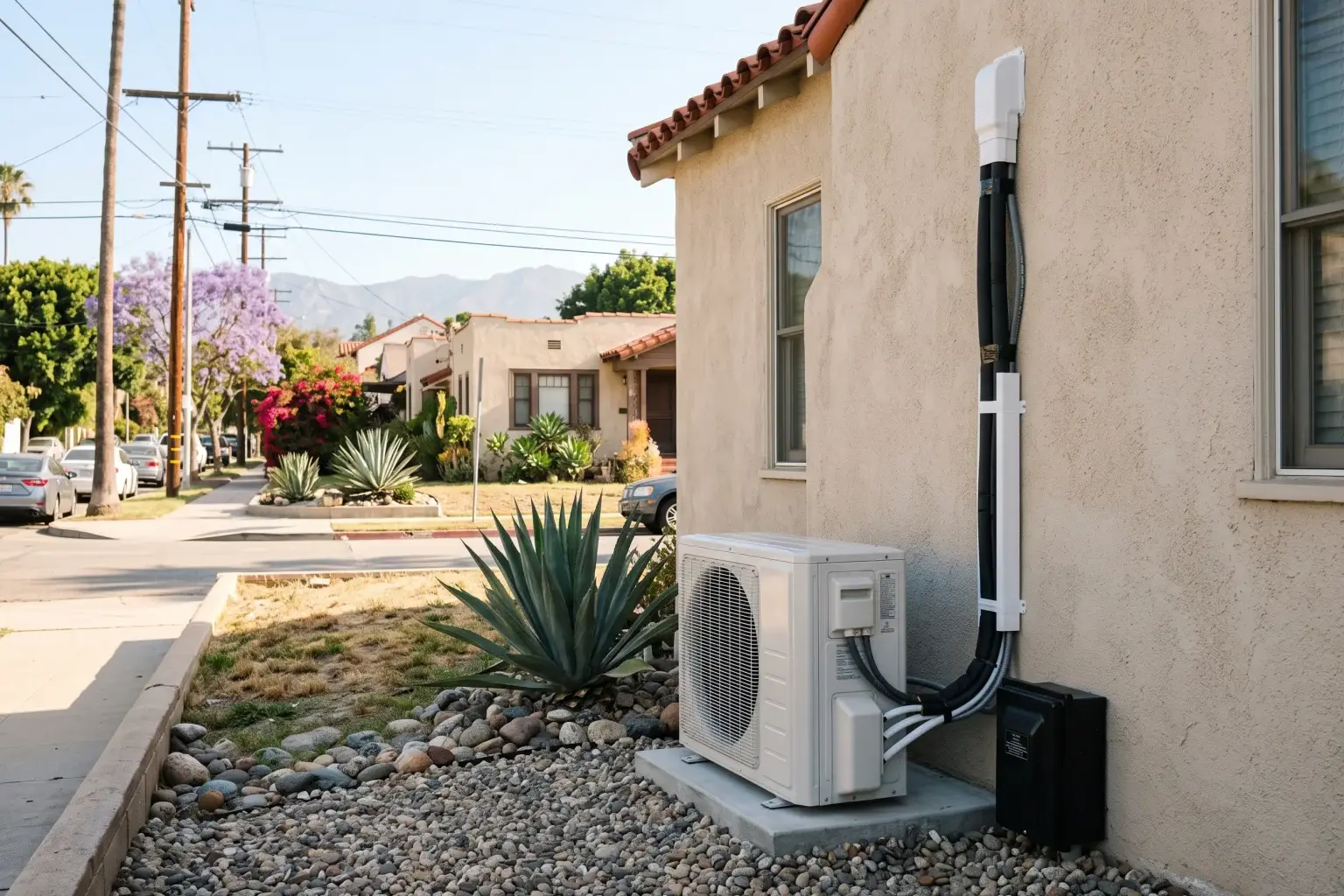
A ductless mini-split heats and cools individual rooms without ductwork. An outdoor heat pump connects to one or more indoor units through a small line set that passes through an exterior wall. In Los Angeles and nearby cities, mini-splits are a common fit for older homes without ducts, converted garages, ADUs, additions, and upstairs rooms that never stay comfortable. This page covers when a mini-split makes sense, what we look at before recommending one, how repair, replacement, and new installation compare, what drives the cost, and what to expect when we visit.
Signs a Mini-Split May Be Right for Your Home
Los Angeles has a Mediterranean climate with dry summers and mild winters, but conditions vary a lot across the region. Valley and inland neighborhoods run much hotter in summer than areas near the coast, and fall Santa Ana winds can bring hot, dry spells late in the season. A home that gets by with open windows and a fan in one neighborhood may need real cooling in another. A mini-split is often the right answer when the problem is a specific room, or when the house was never built for ducts.
- Your home has no ductwork, and window units are noisy, inefficient, or block light and views.
- A bedroom, office, or upstairs room stays hotter or colder than the rest of the house.
- You converted a garage, built an ADU, or added a room that your existing system cannot reach.
- Your wall heater or floor furnace is old, and you want heating and cooling from one system.
- Your ducts are leaky, undersized, or run through a hot attic, and replacing them would be disruptive.
- An older mini-split struggles to keep up, cycles constantly, or leaks water indoors.
What We Check Before Recommending a System
A mini-split works well only when it is sized and placed for the actual space. Before we recommend equipment, we look at the house as it is, not just its square footage.
We also ask how you use each room. A home office used all day needs different capacity and settings than a guest room used a few nights a year.
- Room size, ceiling height, window area, and which direction the windows face
- Insulation in walls and attic, and how much afternoon sun each room gets
- Where indoor units can go so air reaches the room without blowing directly on beds or desks
- A spot for the outdoor unit with good airflow, a stable base, and reasonable distance from bedroom windows and property lines
- The route for the line set and condensate drain, and how it can be finished cleanly on the exterior
- Your electrical panel capacity and whether a new circuit or panel work is needed
- For existing mini-splits: refrigerant charge, coil and filter condition, drain lines, fan motors, sensors, and error codes
Repair, Replace, or Add a New System
If you already have a mini-split, the first question is whether it can be repaired. Clogged drains, dirty coils and filters, failed sensors, and minor refrigerant leaks can often be fixed. We explain what we found and whether a repair is likely to solve the problem or only delay it.
Replacement makes more sense when the compressor has failed, leaks keep coming back, parts are hard to find for an older model, or the system was undersized from the start. Sometimes the existing line set can be reused; often it cannot, and we will tell you why.
For homes without a mini-split, the choice is usually between single-zone systems, which pair one outdoor unit with one indoor unit, and multi-zone systems, which run several indoor units from one outdoor unit. Indoor units come in wall-mounted, ceiling cassette, floor console, and concealed ducted styles. If you are weighing a heat pump against a new gas furnace, keep in mind that South Coast AQMD Rule 1111 limits NOx emissions from gas furnaces sold and installed in the region, and the district has been amending it toward zero-emission requirements. Check the current rule before planning a furnace replacement.
What Affects the Cost
We give a written estimate after we see your home. These are the main factors that move it up or down:
Rebates can lower your net cost. Mini-splits are heat pumps, and LADWP residential electric customers can apply for Consumer Rebate Program rebates on qualifying heat pump systems. The amount depends on the unit's SEER2 and HSPF2 ratings, and you apply after the system is purchased and installed, within 12 months of purchase. Many homes outside the City of Los Angeles are served by Southern California Edison instead, so the rebates available depend on the utility that serves your address. We confirm the current offer before including it in a quote. The federal 25C tax credit covered heat pumps placed in service before December 31, 2025, so it is not available for new installations now.
- Number of zones and indoor units, and the style of each unit
- System capacity and efficiency ratings (SEER2 for cooling, HSPF2 for heating)
- Line set length and route difficulty, including second-story runs and wall finishes
- Electrical work such as a new circuit, disconnect, or panel upgrade
- Mounting for the outdoor unit, such as a ground pad, wall bracket, or roof stand
- Removal of old window units, wall heaters, or an existing mini-split
- Permits required by your city
How a Visit Works
It starts with an in-home assessment. A technician walks the rooms with you, takes measurements, checks the electrical panel, and looks at possible locations for the indoor and outdoor units. For an existing system, the visit is diagnostic, and we test before recommending any parts.
Next, you get a written estimate listing the equipment, where each unit goes, the line set route, and any electrical or permit work. If you decide to go ahead, we schedule the installation. A typical install includes mounting the indoor and outdoor units, making the wall penetration, running and sealing the line set, connecting power and the condensate drain, pulling a vacuum on the system, and checking refrigerant charge and airflow.
Before we leave, we show you how to use the remote or app, set up each zone, and clean the filters. We also explain the routine maintenance the system needs to keep running efficiently.