The short answer
If your AC is blowing warm air, running nonstop, leaking water, or making new noises, it needs a repair visit before a small problem becomes a bigger one. We diagnose the actual cause, explain your repair and replacement options, and give you the price before any work begins.
When your air conditioner stops cooling in the middle of a hot spell, you want a clear answer about what's wrong and what it will take to fix it. AirEdge HVAC Repair Service handles AC repair for homeowners in Los Angeles and nearby cities, including central split systems and heat pumps. We find the cause, explain it in plain terms, and give you options before any work starts. This page covers the warning signs, what our technicians check, how to think about repair versus replacement, what drives the cost, and what happens during a visit.
Signs Your AC Needs Repair
Los Angeles summers are dry, and inland neighborhoods and valleys get much hotter than areas near the coast. Fall Santa Ana winds can also bring hot, dry spells late in the season. Your system often works hardest when a breakdown is most inconvenient. Small problems usually show up before a full failure, so call when you notice any of these:
If you smell burning or the breaker trips more than once, turn the system off at the thermostat and leave it off until it has been inspected.
- Air from the vents is warm or only slightly cool
- The system runs constantly, but the house never reaches the set temperature
- Weak airflow from some or all vents
- The unit turns on and off in short, frequent cycles
- New noises such as grinding, squealing, buzzing, banging, or rattling
- Water pooling near the indoor unit
- Ice on the refrigerant lines or indoor coil
- A burning or musty smell when the system runs
- The breaker trips when the AC starts
- Electric bills climbing without a change in how you use the system
What We Check During an AC Repair Visit
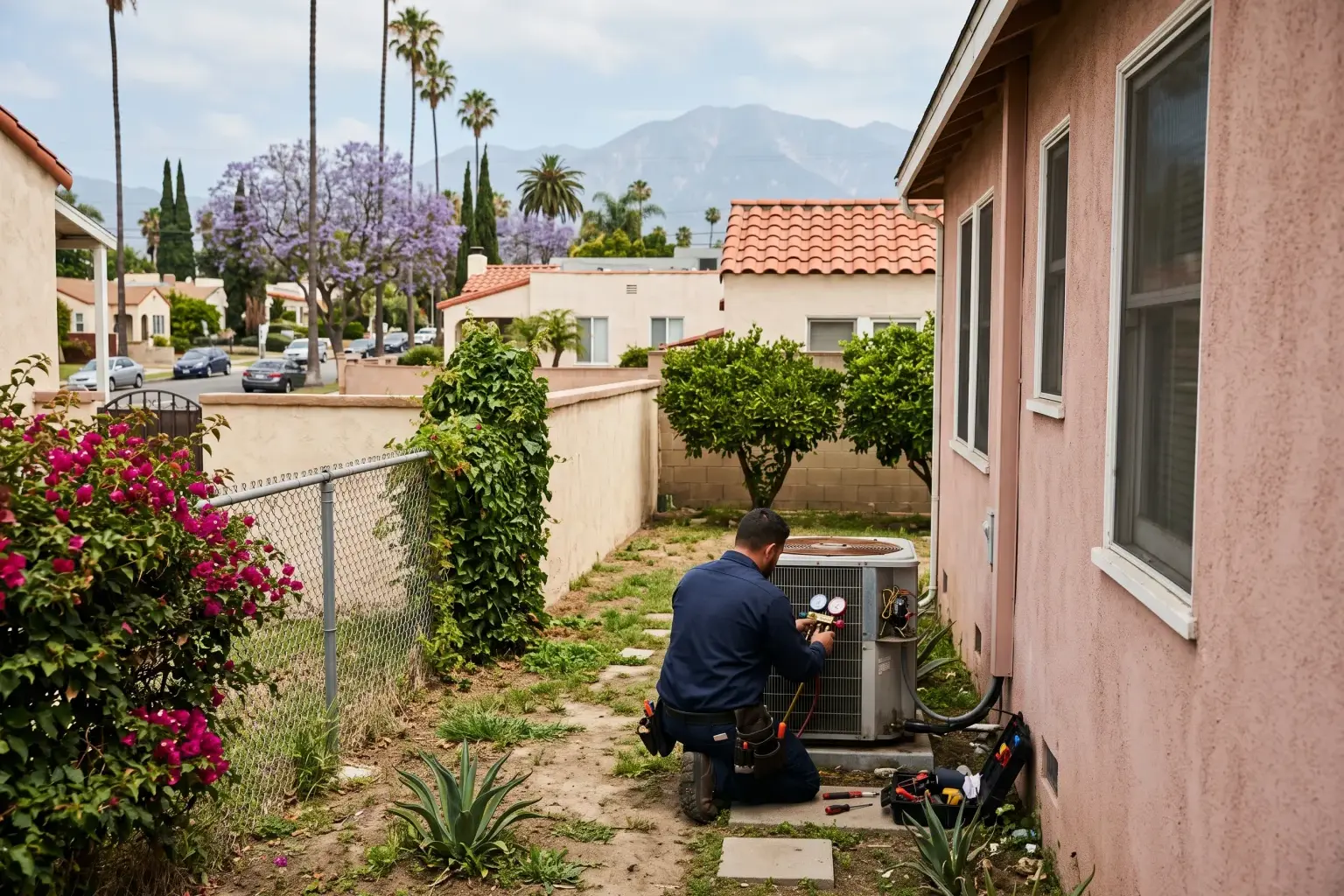
We don't start by swapping parts. One symptom can have several causes. Warm air, for example, can come from low refrigerant, a failed capacitor, a dirty outdoor coil, or a thermostat problem. Our technician works through the system step by step to find what's actually wrong.
Once we've found the cause, we explain what we found, show you the problem where it's practical, and tell you what we recommend and why.
- Thermostat settings, wiring, and power
- Electrical connections, breaker, disconnect, and contactor
- Capacitors and the outdoor fan motor
- Compressor operation and electrical draw
- Refrigerant pressures and signs of a leak
- Indoor and outdoor coils for dirt, damage, or ice
- Blower motor and air filter
- Condensate drain line, drain pan, and float switch
- Supply and return airflow, plus visible ductwork for disconnected or damaged sections
Repair or Replace?
Most AC problems are worth repairing. A failed capacitor, a clogged drain line, a worn contactor, or a dirty coil are common problems with contained fixes. Replacement becomes a real question when a major component fails or when repairs keep stacking up on an aging system. We'll give you a straight view of both paths and weigh these factors with you:
If you're considering a replacement, look at heat pumps, which handle both cooling and heating. LADWP residential electric customers can apply for Consumer Rebate Program rebates on qualifying heat pump systems. The amount is based on the unit's SEER2 and HSPF2 ratings. You file the application after the equipment is purchased and installed, within 12 months of purchase. Many homes outside the City of Los Angeles are served by Southern California Edison instead, so the rebates available to you depend on the utility that serves your address. We confirm the current offer before quoting it. The federal 25C tax credit covered qualifying heat pumps placed in service before December 31, 2025, so it isn't available for new installations now.
If you're also thinking about replacing a gas furnace, South Coast AQMD Rule 1111 limits NOx emissions from gas furnaces sold and installed in the region. The district has been amending the rule toward zero-emission requirements and sets and revises the compliance dates, so check the current rule before you plan a furnace replacement.
- Age and overall condition of the system
- Whether the failed part is a major component, such as the compressor or a coil
- How often the system has needed repairs recently
- Whether the system uses an older refrigerant that is harder to service
- How well the system keeps your home comfortable on the hottest days
- How long you plan to stay in the house
What Affects the Cost of AC Repair
We can't price a repair until we know what's wrong. These are the main factors that affect the cost:
We give you the price for the recommended repair before any work begins, and you decide whether to go ahead.
- Which part failed, and whether it's a common part or one that has to be ordered
- How much labor the repair takes, including access to an indoor unit in an attic, closet, or crawlspace
- Refrigerant type and amount, and whether a leak has to be found and fixed first
- The type and size of your system
- Whether more than one problem is involved
- Timing, such as after-hours or weekend service
How an AC Repair Visit Works
Here's what to expect from the time you contact us to the time your system is running again:
Before we arrive, clear a path to the indoor and outdoor units and note your thermostat settings. Check the air filter and the breaker, too. Sometimes a clogged filter or a tripped breaker is the whole problem.
- You contact us and describe what the system is doing. It helps to mention when the problem started and any noises, smells, or error codes.
- We schedule a visit and let you know when the technician is on the way.
- The technician inspects the system and finds the cause.
- We explain what we found, your options, and the price.
- With your approval, we make the repair.
- We test the system, confirm it's cooling properly, and point out anything you should keep an eye on.
AC Repair by city
- AC Repair in InglewoodLocal service & repairs
- AC Repair in Huntington ParkLocal service & repairs
- AC Repair in VernonLocal service & repairs
- AC Repair in HawthorneLocal service & repairs
- AC Repair in GardenaLocal service & repairs
- AC Repair in South GateLocal service & repairs
- AC Repair in LynwoodLocal service & repairs
- AC Repair in MaywoodLocal service & repairs
- AC Repair in CudahyLocal service & repairs
- AC Repair in ComptonLocal service & repairs
- AC Repair in BellLocal service & repairs
- AC Repair in LawndaleLocal service & repairs